contest no. 5
Eurovision 1960: London
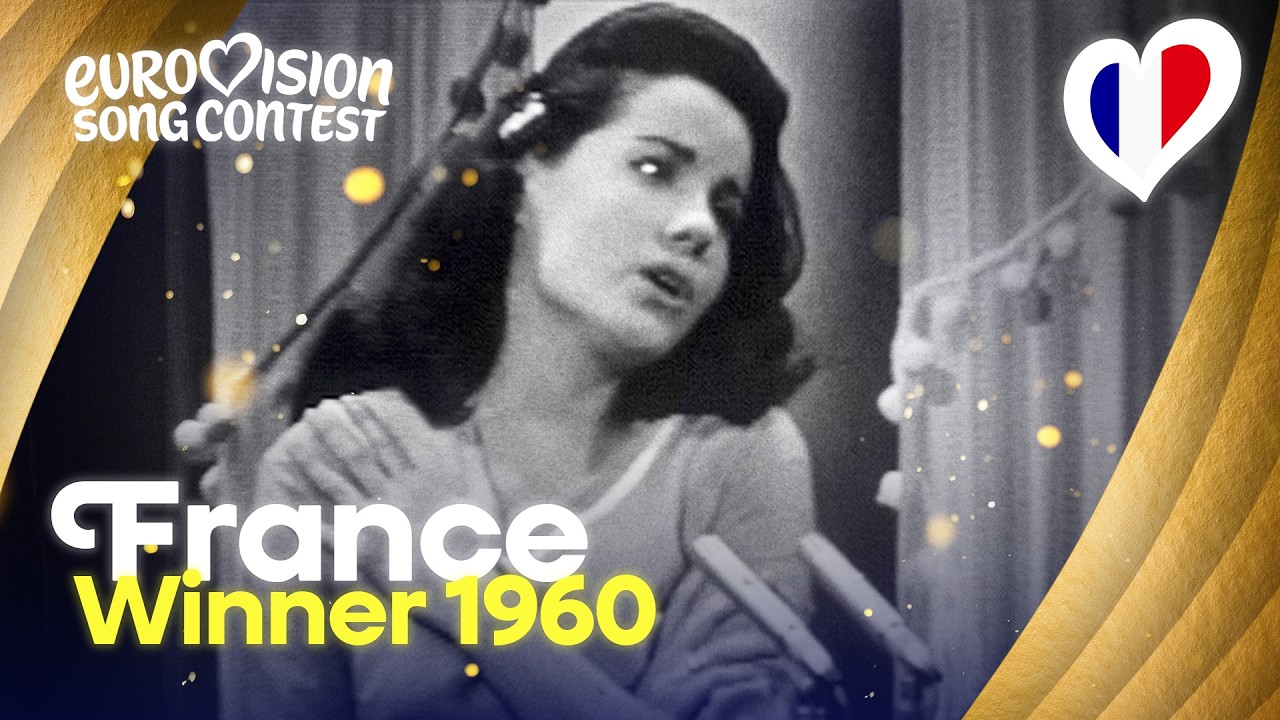
The 5th Eurovision Song Contest was held on Tuesday, 29 March 1960 at Royal Festival Hall in London, United Kingdom. 13 countries took part. France won with “Tom Pillibi” by Jacqueline Boyer, on 32 points.
How would you have voted? Rank all 13 songs from 1960
- Date
- Tuesday, 29 March 1960
- Venue
- Royal Festival Hall, London, United Kingdom
- Host broadcaster
- British Broadcasting Corporation (BBC)
- Presenter
- Catherine Boyle
- Director
- Innes Lloyd
- Musical director
- Eric Robinson
- Entries
- 13 countries
- Debut
- Norway
- Returning
- Luxembourg
- Voting
- Ten-member juries in each country; each member gave one vote to their favourite song
The story
London steps in, and a last-placed singer's daughter wins
The Netherlands won in 1959 and did not want the contest back. It had hosted in 1958 and wasn’t prepared to pay for it twice in three years. So the 1960 contest went to the country that had come second: in October 1959 the BBC was confirmed as host.
The hall
The BBC put it in the Royal Festival Hall on the South Bank of the Thames, built for the Festival of Britain in 1951. More than 2,500 people were in the audience.
The show went out on a Tuesday night, 29 March, and ran for an hour and twenty minutes. Catherine Boyle, known to everyone as Katie, presented. It was the first of four contests she would host, which is still a record.
She opened the show and ran the voting. Between the songs, viewers heard their own country’s commentator instead — and the audience in the hall heard the British one, David Jacobs, over the speakers.
Thirteen
Luxembourg came back after its year away, and Norway entered for the first time. With the eleven from Cannes that made thirteen.
Luxembourg’s Camillo Felgen sang in Luxembourgish, the first time the language had been heard at the contest. Only two entries have used it since.
Belgium sent Fud Leclerc again. It was his third contest in five years.
A small change with a long life
The voting worked as before: ten jurors in each country, one vote each. But this year the juries were allowed to hear the songs in advance. The final rehearsal was recorded and played to them before the live show.
The running order was drawn the day before the contest, with the singers in the room.
The result
France won for the second time, drawing level with the Netherlands. “Tom Pillibi”, sung by Jacqueline Boyer, took 32 of the 130 votes.
There was a family story in it. Boyer’s father, Jacques Pills, had sung for Monaco the year before and finished last, with a single vote. Twelve months later his daughter won the whole thing.
The United Kingdom was second for the second year running, this time with Bryan Johnson. Monaco, last in 1959, came third. Luxembourg’s return ended at the bottom of the board with one vote.
Two things that stuck
The plan had been to repeat what Cannes did and have the top three all sing again. It was dropped; only the winner got an encore.
And the prize, a silver-gilt vase, was handed over by the previous year’s winner, Teddy Scholten. Nobody had done that before. It became the custom.
Sources: Wikipedia, “Eurovision Song Contest 1960”, and the EBU records and press reports it cites.
On the night
How the show opened, and what filled the interval while the votes came in.
-
Tuesday, 29 March 1960
The contest
13 songs
Our sources don’t record how this one opened or what filled the interval.
Every entry
| Place | Country | Artist | Song | Points | Sang |
|---|---|---|---|---|---|
| 1 | France | Jacqueline Boyer winner! | “Tom Pillibi” French · Pierre Cour, André Popp · conducted by Franck Pourcel | 32 | 13 |
| 2 | United Kingdom | Bryan Johnson | “Looking High, High, High” English · John Watson · conducted by Eric Robinson | 25 | 1 |
| 3 | Monaco | François Deguelt | “Ce soir-là” French · Pierre Dorsey, Hubert Giraud · conducted by Raymond Lefèvre | 15 | 8 |
| 4 | Norway | Nora Brockstedt | “Voi-voi” Norwegian · Georg Elgaaen · conducted by Øivind Bergh | 11 | 6 |
| 4 | Germany | Wyn Hoop | “Bonne nuit ma chérie” German · Franz Josef Breuer, Kurt Schwabach · conducted by Franz Josef Breuer | 11 | 11 |
| 6 | Belgium | Fud Leclerc | “Mon amour pour toi” French · Robert Montal, Jack Say · conducted by Henri Segers | 9 | 5 |
| 7 | Austria | Harry Winter | “Du hast mich so fasziniert” German · Robert Gilbert, Robert Stolz · conducted by Robert Stolz | 6 | 7 |
| 8 | Switzerland | Anita Traversi | “Cielo e terra” Italian · Mario Robbiani · conducted by Cédric Dumont | 5 | 9 |
| 8 | Italy | Renato Rascel | “Romantica” Italian · Renato Rascel, Dino Verde · conducted by Cinico Angelini | 5 | 12 |
| 10 | Sweden | Siw Malmkvist | “Alla andra får varann” Swedish · Åke Gerhard, Ulf Källqvist · conducted by Thore Ehrling | 4 | 2 |
| 10 | Denmark | Katy Bødtger | “Det var en yndig tid” Danish · Sven Buemann, Vilfred Kjær · conducted by Kai Mortensen | 4 | 4 |
| 12 | Netherlands | Rudi Carrell | “Wat een geluk” Dutch · Willy van Hemert, Dick Schallies · conducted by Dolf van der Linden | 2 | 10 |
| 13 | Luxembourg | Camillo Felgen | “So laang we's du do bast” Luxembourgish · Henri Moots, Jean Roderès · conducted by Eric Robinson | 1 | 3 |


Who showed it, and who talked over it
The channels that carried the contest in 14 countries, with the commentator where our source names one.
-
Austria
- ORF
-
Belgium
- INR Pierre Tchernia
- NIR Nic Bal
-
Denmark
- Danmarks Radio TV, Program 2 Sejr Volmer-Sørensen
-
France
- RTF Pierre Tchernia
-
Germany
- Deutsches Fernsehen Wolf Mittler
-
Italy
- RAI Televisione, Secondo Programma Giorgio Porro
-
Luxembourg
- Télé-Luxembourg
-
Netherlands
- NTS Piet te Nuyl Jr.
- Hilversum 2
-
Norway
- NRK Fjernsynet, NRK Erik Diesen
-
Sweden
- Sveriges TV, SR P2 Jan Gabrielsson
-
Switzerland
- TV DRS, Radio Beromünster Theodor Haller
- TSR, Radio Sottens
- TSI, Radio Monte Ceneri
-
United Kingdom
- BBC Television Service David Jacobs
Also shown in
-
Finland
- Suomen Televisio Aarno Walli
-
Netherlands Antilles
- RNW
Results as published by the European Broadcasting Union. Spotted a mistake? Tell us and we'll fix it.