contest no. 9
Eurovision 1964: Copenhagen
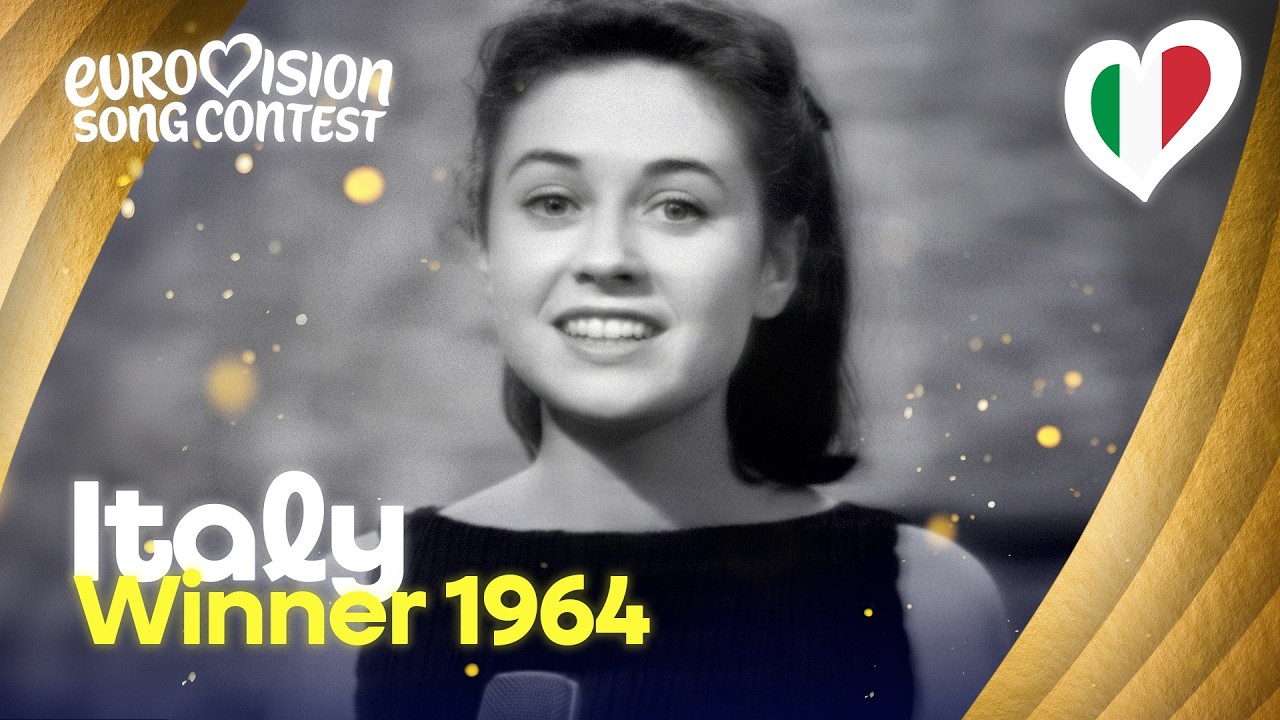
The 9th Eurovision Song Contest was held on Saturday, 21 March 1964 at Tivolis Koncertsal in Copenhagen, Denmark. 16 countries took part. Italy won with “Non ho l'età” by Gigliola Cinquetti, on 49 points.
How would you have voted? Rank all 16 songs from 1964
- Date
- Saturday, 21 March 1964
- Venue
- Tivolis Koncertsal, Copenhagen, Denmark
- Host broadcaster
- Danmarks Radio (DR)
- Presenter
- Lotte Wæver
- Director
- Poul Leth Sørensen
- Musical director
- Kai Mortensen
- For the EBU
- Miroslav Vilček
- Entries
- 16 countries
- Debut
- Portugal
- Absent
- Sweden
- Voting
- Each country awarded 5, 3 and 1 points (or combinations thereof) to their three favourite songs
The story
A banner on the stage, and the biggest landslide there has been
The 1964 contest was held in an amusement park. Denmark, the holder, put it in the concert hall inside Copenhagen’s Tivoli Gardens, in front of 800 people. Two things happened there that had never happened at the contest before: someone used it for a political protest, and someone won it by a distance that has never been matched.
Who was missing, and who was new
Sweden stayed away. Its performers’ union was on strike, and the broadcaster could not send an entry.
Portugal took its place in the sixteen, competing for the first time. It did not go well: Portugal became the first country to score nothing on its debut.
There were other firsts in the line-up. The Dutch singer Anneke Grönloh, who was of Indonesian descent, was the first performer at the contest with non-European ancestry. And Spain sent a trio — the first act with three people on stage.
Switzerland’s Anita Traversi had been here in 1960. A hundred or so journalists and photographers covered the event, and a 41-piece orchestra played.
The man with the banner
Switzerland had just finished singing when a man walked onto the stage holding up a banner. It read “Boycot Franco & Salazar” — the dictators of Spain and Portugal, both of whose countries were competing that night.
Viewers at home saw very little of it. The director cut to a shot of the scoreboard and held it there until a technician had taken the man off. Then the show carried on.
A second bow
Italy’s Gigliola Cinquetti sang “Non ho l’età”. The hall’s reaction was so loud, and went on for so long, that she was let back on stage to take a second bow — something performers at the contest simply weren’t given.
British television repeated her performance the next afternoon, unscheduled.
The result
The scoring was the same idea as before with different numbers: each jury gave five, three and one points to its top three.
Cinquetti finished with 49. The United Kingdom’s Matt Monro, in second place, had 17. No winner has ever been further ahead of the field in proportion: almost three times the score of the runner-up.
Monaco was third. At the bottom, four countries had nothing: Portugal on its debut, and Germany, Switzerland and Yugoslavia, each scoring zero for the first time.
Nobody left empty-handed, though. At the party afterwards, every one of the sixteen acts was given a silver trophy.
Sources: Wikipedia, “Eurovision Song Contest 1964”, and the EBU records it cites.
On the night
How the show opened, and what filled the interval while the votes came in.
-
Saturday, 21 March 1964
The contest
16 songs
- in the interval
-
- Dancers of the Royal Danish Ballet Solveig Østergaard, Niels Kehlet, Inge Olafsen and Mette Hønningen in a ballet by Niels Bjørn Larsen, to music by Hans Christian Lumbye
Every entry
| Place | Country | Artist | Song | Points | Sang |
|---|---|---|---|---|---|
| 1 | Italy | Gigliola Cinquetti winner! | “Non ho l'età” Italian · Mario Panzeri, Nicola Salerno · conducted by Gianfranco Monaldi | 49 | 12 |
| 2 | United Kingdom | Matt Monro | “I Love the Little Things” English · Tony Hatch · conducted by Harry Rabinowitz | 17 | 8 |
| 3 | Monaco | Romuald | “Où sont-elles passées ?” French · Pierre Barouh, Francis Lai · conducted by Michel Colombier | 15 | 10 |
| 4 | Luxembourg | Hugues Aufray | “Dès que le printemps revient” French · Hugues Aufray, Jacques Plante · conducted by Jacques Denjean | 14 | 1 |
| 4 | France | Rachel | “Le Chant de Mallory” French · Pierre Cour, André Popp · conducted by Franck Pourcel | 14 | 7 |
| 6 | Austria | Udo Jürgens | “Warum nur, warum?” German · Udo Jürgens · conducted by Johannes Fehring | 11 | 6 |
| 7 | Finland | Lasse Mårtenson | “Laiskotellen” Finnish · Lasse Mårtenson, Sauvo Puhtila · conducted by George de Godzinsky | 9 | 5 |
| 8 | Norway | Arne Bendiksen | “Spiral” Norwegian · Egil Hagen, Sigurd Jansen · conducted by Karsten Andersen | 6 | 3 |
| 9 | Denmark | Bjørn Tidmand | “Sangen om dig” Danish · Mogens Dam, Aksel V. Rasmussen · conducted by Kai Mortensen | 4 | 4 |
| 10 | Netherlands | Anneke Grönloh | “Jij bent mijn leven” Dutch · Ted Powder, René de Vos · conducted by Dolf van der Linden | 2 | 2 |
| 10 | Belgium | Robert Cogoi | “Près de ma rivière” French · Robert Cogoi · conducted by Henri Segers | 2 | 15 |
| 12 | Spain | Nelly with Tim and Tony | “Caracola” Spanish · Fina de Calderón · conducted by Rafael Ibarbia | 1 | 16 |
| 13 | Germany | Nora Nova | “Man gewöhnt sich so schnell an das Schöne” German · Rudi von der Dovenmühle, Nils Nobach · conducted by Willy Berking | 0 | 9 |
| 13 | Portugal | António Calvário | “Oração” Portuguese · Rogério Braçinha, João Nobre, Francisco Nicholson · conducted by Kai Mortensen | 0 | 11 |
| 13 | Yugoslavia | Sabahudin Kurt | “Život je sklopio krug (Живот је склопио круг)” Serbo-Croatian · Srđan Matijević, Stevan Raičković · conducted by Radivoje Spasić | 0 | 13 |
| 13 | Switzerland | Anita Traversi | “I miei pensieri” Italian · Sanzio Chiesa, Giovanni Pelli · conducted by Fernando Paggi | 0 | 14 |


Who showed it, and who talked over it
The channels that carried the contest in 20 countries, with the commentator where our source names one.
-
Austria
- ORF
-
Belgium
- RTB
- BRT
-
Denmark
- DR TV, DR P1, DR P3 Claus Walter
-
Finland
- Suomen Televisio Aarno Walli
- Yleisohjelma Erkki Melakoski
- Ruotsinkielinen ula-ohjelma
-
France
- RTF, Inter Jeunesse Robert Beauvais
-
Germany
- Deutsches Fernsehen Hermann Rockmann
-
Italy
- Programma Nazionale TV Renato Tagliani
-
Luxembourg
- Télé-Luxembourg Robert Beauvais
-
Monaco
- Télé Monte-Carlo Robert Beauvais
-
Netherlands
- NTS Ageeth Scherphuis
- Hilversum 2
-
Norway
- NRK Fjernsynet, NRK Odd Grythe
-
Portugal
- RTP
-
Spain
- TVE Federico Gallo
- RNE
-
Switzerland
- TV DRS
- TSR Robert Burnier
- TSI
- Radio Beromünster
- Radio Sottens
- Radio Monte Ceneri
-
United Kingdom
- BBC TV David Jacobs
-
Yugoslavia
- Televizija Beograd
- Televizija Ljubljana
- Televizija Zagreb
Also shown in
Results as published by the European Broadcasting Union. Spotted a mistake? Tell us and we'll fix it.