contest no. 8
Eurovision 1963: London
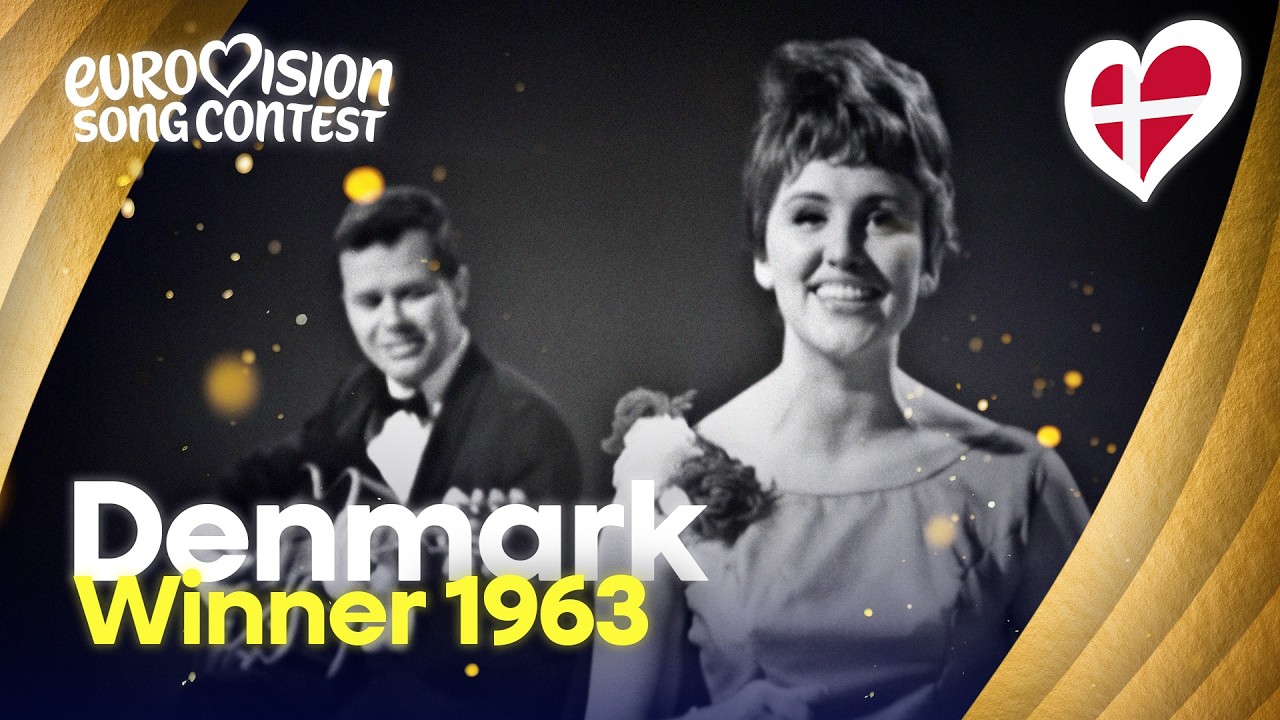
The 8th Eurovision Song Contest was held on Saturday, 23 March 1963 at BBC Television Centre in London, United Kingdom. 16 countries took part. Denmark won with “Dansevise” by Grethe and Jørgen Ingmann, on 42 points.
How would you have voted? Rank all 16 songs from 1963
- Date
- Saturday, 23 March 1963
- Venue
- BBC Television Centre, London, United Kingdom
- Host broadcaster
- British Broadcasting Corporation (BBC)
- Presenter
- Katie Boyle
- Director
- Yvonne Littlewood
- Musical director
- Eric Robinson
- For the EBU
- Miroslav Vilček
- Entries
- 16 countries
- Voting
- Each country awarded 5-1 points to their five favourite songs
The story
Two studios, and a vote that was read out twice
Denmark won the 1963 contest by two points. Whether it should have is an argument that started before the broadcast ended and took a month to settle.
London again
France had won in 1962 and passed on hosting. Its broadcaster pointed to the cost, and to the fact that it had already staged the contest twice, in 1959 and 1961. The BBC stepped in, as it had in 1960.
This time it kept the show in-house: the new Television Centre at White City, which had opened in 1960. Katie Boyle presented for the second time.
A contest made for television
Every contest before this one had been a concert with cameras pointed at it. The BBC made a television programme instead.
It used two studios. One held Boyle, the audience and the scoreboard. The other held the orchestra and the singers, who performed to cameras rather than to a hall. That allowed sets and close-ups nobody had tried before.
It also had a side effect. The sound was picked up by a boom microphone held out of shot, the way a drama would be recorded, so viewers saw singers with no microphone anywhere near them. It could look as though they were miming. They weren’t.
The sixteen countries were the same sixteen for the third year running. Ronnie Carroll sang for the United Kingdom again.
Twenty jurors and a lot of arithmetic
The voting changed once more. Each country now had twenty jurors, who each ranked their five favourite songs. The votes were added up, and the jury’s overall top five received five, four, three, two and one points.
More jurors and more sums meant more time needed. That turned out to matter.
Norway votes twice
When Boyle reached Oslo, the Norwegian spokesman read his results in the wrong format. He was supposed to give each song’s number and country before its points, and didn’t. Boyle asked him to start again. He asked her instead to come back to Norway at the end.
She did. The votes he read the second time were not the votes he had read the first time — and the difference decided the contest. On the first reading Switzerland would have won. On the second, Denmark did.
The explanation given was that the first set had never been the real result: Norway’s twenty jurors were still being tallied when the call came, and the spokesman had read out numbers that weren’t final. Swiss television was reported to be preparing an appeal. After a flood of complaints the recordings of the vote were checked, and a month after the contest it was confirmed that the Norwegian jury had not changed its votes.
Monaco had to be called twice as well. Its spokesman had given one point each to two different songs. On the recount the second of them was dropped; it made no difference to anyone’s placing.
The result
Denmark’s Grethe and Jørgen Ingmann won with “Dansevise”, 42 points to Switzerland’s 40. It was the first win for any Nordic country, and the closest finish the contest had had.
Italy was third. Further down were two singers who would become far bigger than the contest: Françoise Hardy, fifth for Monaco, and Nana Mouskouri, eighth for Luxembourg.
Four countries scored nothing. For Finland, Norway and Sweden it was a first. For the Netherlands it was the second year in a row — the first country to manage that.
Sources: Wikipedia, “Eurovision Song Contest 1963”, and the EBU records it cites.
On the night
How the show opened, and what filled the interval while the votes came in.
-
Saturday, 23 March 1963
The contest
16 songs
- in the interval
-
- Ola and Barbro
Every entry
| Place | Country | Artist | Song | Points | Sang |
|---|---|---|---|---|---|
| 1 | Denmark | Grethe and Jørgen Ingmann winner! | “Dansevise” Danish · Otto Francker, Sejr Volmer-Sørensen · conducted by Kai Mortensen | 42 | 8 |
| 2 | Switzerland | Esther Ofarim | “T'en va pas” French · Émile Gardaz, Géo Voumard · conducted by Eric Robinson | 40 | 10 |
| 3 | Italy | Emilio Pericoli | “Uno per tutte” Italian · Giulio Rapetti, Tony Renis, Alberto Testa · conducted by Gigi Cichellero | 37 | 6 |
| 4 | United Kingdom | Ronnie Carroll | “Say Wonderful Things” English · Philip Green, Norman Newell · conducted by Eric Robinson | 28 | 1 |
| 5 | France | Alain Barrière | “Elle était si jolie” French · Alain Barrière · conducted by Franck Pourcel | 25 | 11 |
| 5 | Monaco | Françoise Hardy | “L'amour s'en va” French · Françoise Hardy · conducted by Raymond Lefèvre | 25 | 15 |
| 7 | Austria | Carmela Corren | “Vielleicht geschieht ein Wunder” German, English · Erwin Halletz, Norman Newell, Peter Wehle · conducted by Erwin Halletz | 16 | 4 |
| 8 | Luxembourg | Nana Mouskouri | “À force de prier” French · Raymond Bernard, Pierre Delanoë · conducted by Eric Robinson | 13 | 16 |
| 9 | Germany | Heidi Brühl | “Marcel” German · Charly Niessen · conducted by Willy Berking | 5 | 3 |
| 10 | Belgium | Jacques Raymond | “Waarom?” Dutch · Wim Brabants, Hans Flower · conducted by Francis Bay | 4 | 14 |
| 11 | Yugoslavia | Vice Vukov | “Brodovi (Бродови)” Serbo-Croatian · Mario Nardelli · conducted by Miljenko Prohaska | 3 | 9 |
| 12 | Spain | José Guardiola | “Algo prodigioso” Spanish · Fernando García Morcillo, Camillo Murillo Janero · conducted by Rafael Ibarbia | 2 | 12 |
| 13 | Netherlands | Annie Palmen | “Een speeldoos” Dutch · Pieter Goemans · conducted by Eric Robinson | 0 | 2 |
| 13 | Norway | Anita Thallaug | “Solhverv” Norwegian · Dag Kristoffersen · conducted by Øivind Bergh | 0 | 5 |
| 13 | Finland | Laila Halme | “Muistojeni laulu” Finnish · Börje Sundgren · conducted by George de Godzinsky | 0 | 7 |
| 13 | Sweden | Monica Zetterlund | “En gång i Stockholm” Swedish · Bobbie Ericson, Beppe Wolgers · conducted by William Lind | 0 | 13 |


Who showed it, and who talked over it
The channels that carried the contest in 18 countries, with the commentator where our source names one.
-
Austria
- ORF Hanns Joachim Friedrichs
-
Belgium
- BRT Bob Boon and Denise Maes
- RTB Pierre Delhasse
-
Denmark
- Danmarks Radio TV, Program 1 Ole Mortensen
-
Finland
- Suomen Televisio Aarno Walli
- Yleisohjelma Erkki Melakoski
- Ruotsinkielinen yleisohjelma Jan Sederholm
-
France
- RTF Pierre Tchernia
-
Germany
- Deutsches Fernsehen Hanns Joachim Friedrichs
-
Italy
- Programma Nazionale TV Renato Tagliani
-
Luxembourg
- Télé-Luxembourg Pierre Tchernia
-
Monaco
- Télé Monte-Carlo Pierre Tchernia
-
Netherlands
- NTS Willem Duys
- Hilversum 1 Coen Serré
-
Norway
- NRK Fjernsynet, NRK Øivind Johnssen
-
Spain
- TVE Federico Gallo
- RNE
-
Sweden
- Sveriges TV, SR P1 Jörgen Cederberg
-
Switzerland
- TV DRS Theodor Haller
- TSR Georges Hardy
- TSI Renato Tagliani
- Radio Beromünster
- Radio Sottens
- Radio Monte Ceneri
-
United Kingdom
- BBC TV David Jacobs
-
Yugoslavia
- Televizija Beograd, Televizija Ljubljana, Televizija Zagreb Saša Novak
Also shown in
Results as published by the European Broadcasting Union. Spotted a mistake? Tell us and we'll fix it.