contest no. 7
Eurovision 1962: Luxembourg City
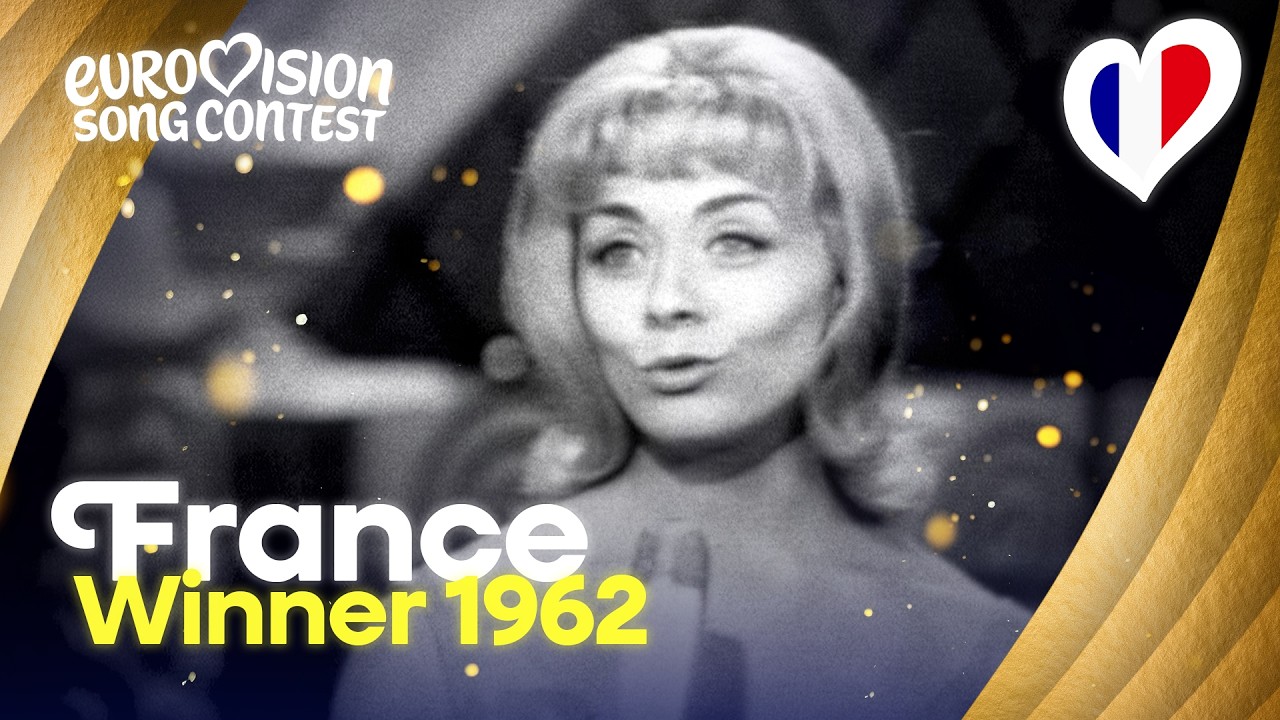
The 7th Eurovision Song Contest was held on Sunday, 18 March 1962 at Villa Louvigny in Luxembourg City, Luxembourg. 16 countries took part. France won with “Un premier amour” by Isabelle Aubret, on 26 points.
How would you have voted? Rank all 16 songs from 1962
- Date
- Sunday, 18 March 1962
- Venue
- Villa Louvigny, Luxembourg City, Luxembourg
- Host broadcaster
- Compagnie Luxembourgeoise de Télédiffusion (CLT)
- Presenter
- Mireille Delannoy
- Directors
- Jos Pauly, René Steichen
- Musical director
- Jean Roderès
- Entries
- 16 countries
- Voting
- Each country awarded 3, 2 and 1 points to their three favourite songs
The story
The lights go out, and nul points is born
Luxembourg hosted for the first time in 1962, in the Grand Auditorium of the Villa Louvigny, its broadcaster’s headquarters in the city’s municipal park. It is the contest where the power failed twice and where four countries went home with nothing — the first time anyone had.
The same sixteen
For the first time since the contest began, the list of countries didn’t change. All sixteen from Cannes came back and nobody new joined.
Half the singers were, or would become, repeat visitors. Belgium’s Fud Leclerc was making his fourth appearance, the first artist to reach that number; only three acts have matched it since. And Jean Philippe, who had sung for France in 1959, turned up representing Switzerland — the first person to sing for two different countries.
New sums
The voting was rebuilt. Instead of ten jurors casting one vote each, every jury now agreed its three favourite songs and gave them three points, two points and one.
It made the scoreboard easier to follow. It also meant a song could be every jury’s fourth choice and score nothing at all.
The juries were meant to stand for the ordinary viewer and listener. Composers, publishers and record-company staff were not allowed to sit on them.
A Sunday, a clown, and the dark
The show went out on Sunday 18 March at half past nine in the evening. It is the last time the final wasn’t held on a Saturday. Mireille Delannoy, one of the station’s continuity announcers, presented; her four-year-old son had helped her draw the running order two days earlier.
The interval act was the French clown Achille Zavatta, performing as the contest’s seventeenth entrant, for a country called Zavattaland.
Then there was the electricity. During the Dutch song, eighth in the running order, the power dipped: the picture degraded, and some broadcasters lost it altogether for around thirty seconds. Straight after the next song, France’s, it happened again, worse. The auditorium went completely dark for about a minute and a half. Broadcasters put up their “breakdown” captions, and Norway’s singer had to wait.
The result
France won, with Isabelle Aubret and “Un premier amour” on 26 points. It was France’s third win in five years, and the first time any country had won three times.
Monaco was second and the hosts third, which meant the top three songs were all in French. Monaco’s François Deguelt had been third in 1960; he became the first singer to finish both second and third without ever winning.
Nul points
Four countries scored nothing: Austria, Belgium, the Netherlands and Spain. It had never happened before, and the new system made it likely: with each jury rewarding only three songs, most of the field got nothing from most of the room.
Two of the four had particular reason to feel hard done by. Fud Leclerc’s record-setting fourth appearance ended on zero. And the Dutch duo De Spelbrekers were the ones singing when the lights first went.
The winner’s medallion carried a winged lion, the emblem of the host broadcaster. Jean-Claude Pascal, the previous year’s winner, presented it.
Sources: Wikipedia, “Eurovision Song Contest 1962”, and the EBU records and press reports it cites.
On the night
How the show opened, and what filled the interval while the votes came in.
-
Sunday, 18 March 1962
The contest
16 songs
- in the interval
-
- Achille Zavatta the French clown, in a sketch as the contest’s seventeenth entrant, singing for “Zavattaland”
Every entry
| Place | Country | Artist | Song | Points | Sang |
|---|---|---|---|---|---|
| 1 | France | Isabelle Aubret winner! | “Un premier amour” French · Roland Valade, Claude-Henri Vic · conducted by Franck Pourcel | 26 | 9 |
| 2 | Monaco | François Deguelt | “Dis rien” French · René Rouzaud, Henri Salvador · conducted by Raymond Lefèvre | 13 | 16 |
| 3 | Luxembourg | Camillo Felgen | “Petit bonhomme” French · Jacques Datin, Maurice Vidalin · conducted by Jean Roderès | 11 | 14 |
| 4 | Yugoslavia | Lola Novaković | “Ne pali svetla u sumrak (Не пали светла у сумрак)” Serbo-Croatian · Dragutin Britvić, Jože Privšek · conducted by Jože Privšek | 10 | 12 |
| 4 | United Kingdom | Ronnie Carroll | “Ring-A-Ding Girl” English · Stan Butcher, Syd Cordell · conducted by Angela Morley | 10 | 13 |
| 6 | Germany | Conny Froboess | “Zwei kleine Italiener” German · Christian Bruhn, Georg Buschor · conducted by Rolf-Hans Müller | 9 | 7 |
| 7 | Finland | Marion Rung | “Tipi-tii” Finnish · Jaakko Salo, Kari Tuomisaari · conducted by George de Godzinsky | 4 | 1 |
| 7 | Sweden | Inger Berggren | “Sol och vår” Swedish · Åke Gerhard, Ulf Källqvist · conducted by Egon Kjerrman | 4 | 6 |
| 9 | Italy | Claudio Villa | “Addio, addio” Italian · Franco Migliacci, Domenico Modugno · conducted by Cinico Angelini | 3 | 15 |
| 10 | Denmark | Ellen Winther | “Vuggevise” Danish · Kjeld Bonfils, Sejr Volmer-Sørensen · conducted by Kai Mortensen | 2 | 5 |
| 10 | Norway | Inger Jacobsen | “Kom sol, kom regn” Norwegian · Ivar Andersen, Kjell Karlsen · conducted by Øivind Bergh | 2 | 10 |
| 10 | Switzerland | Jean Philippe | “Le Retour” French · Émile Gardaz, Géo Voumard · conducted by Cédric Dumont | 2 | 11 |
| 13 | Belgium | Fud Leclerc | “Ton nom” French · Eric Channe, Tony Golan · conducted by Henri Segers | 0 | 2 |
| 13 | Spain | Víctor Balaguer | “Llámame” Spanish · Miguel Portolés, Mario Sellés · conducted by Jean Roderès | 0 | 3 |
| 13 | Austria | Eleonore Schwarz | “Nur in der Wiener Luft” German · Bruno Uher · conducted by Bruno Uher | 0 | 4 |
| 13 | Netherlands | De Spelbrekers | “Katinka” Dutch · Henny Hamhuis, Lodewijk Post, Joop Stokkermans · conducted by Dolf van der Linden | 0 | 8 |


Who showed it, and who talked over it
The channels that carried the contest in 16 countries, with the commentator where our source names one.
-
Austria
- ORF
-
Belgium
- RTB
- BRT Willem Duys
-
Denmark
- Danmarks Radio TV, Program 2 Ole Mortensen
-
Finland
- Suomen Televisio Aarno Walli
- Yleisohjelma Erkki Melakoski
- Ruotsinkielinen yleisohjelma Jan Sederholm
-
France
- RTF Pierre Tchernia
- France I
-
Germany
- Deutsches Fernsehen Ruth Kappelsberger
-
Italy
- Programma Nazionale TV Renato Tagliani
-
Luxembourg
- Télé-Luxembourg, Radio Luxembourg
-
Monaco
- Radio Monte Carlo
-
Netherlands
- NTS Willem Duys
- Hilversum 2
-
Norway
- NRK Fjernsynet, NRK Odd Grythe
-
Spain
- TVE Federico Gallo
- RNE
-
Sweden
- Sveriges TV, SR P1 Jan Gabrielsson
-
Switzerland
- TV DRS
- TSR Pierre Tchernia
- TSI Giovanni Bertini
- Radio Genève
- Radio Monte Ceneri
-
United Kingdom
- BBC TV David Jacobs
-
Yugoslavia
- Televizija Beograd
- Televizija Ljubljana
- Televizija Zagreb
Results as published by the European Broadcasting Union. Spotted a mistake? Tell us and we'll fix it.