contest no. 18
Eurovision 1973: Luxembourg City
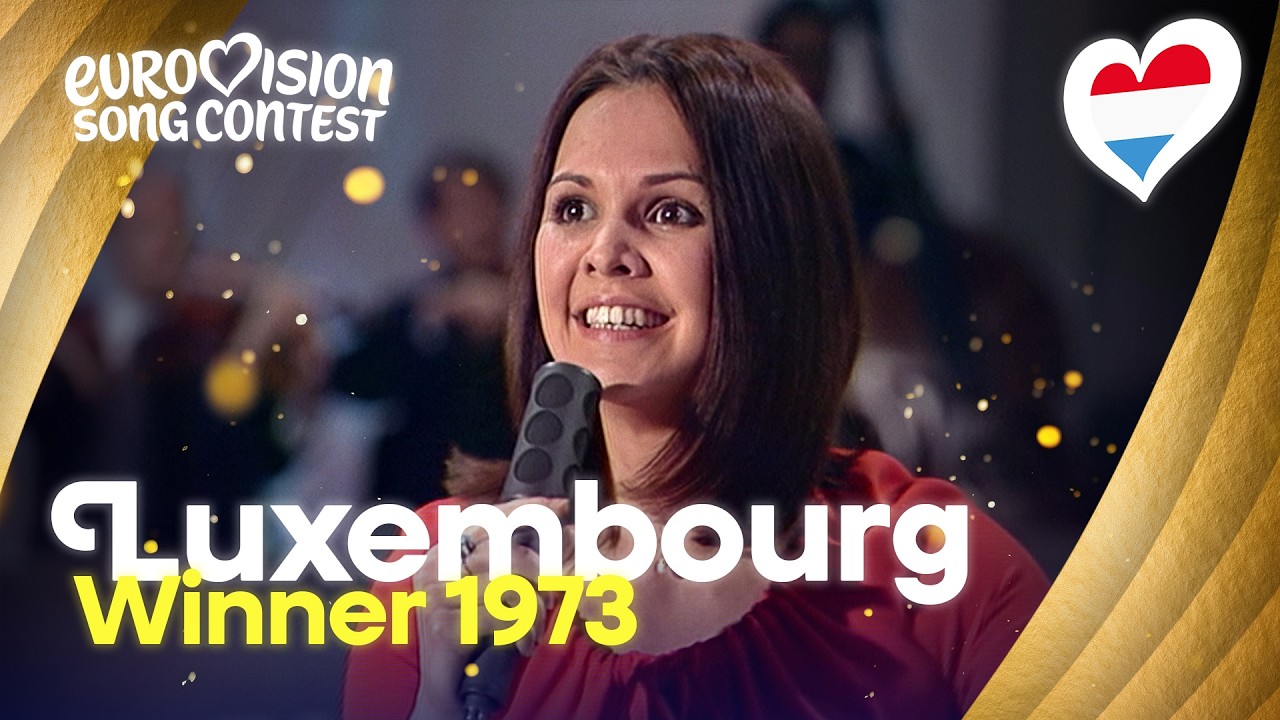
The 18th Eurovision Song Contest was held on Saturday, 7 April 1973 at Nouveau Théâtre in Luxembourg City, Luxembourg. 17 countries took part. Luxembourg won with “Tu te reconnaîtras” by Anne-Marie David, on 129 points.
How would you have voted? Rank all 17 songs from 1973
- Date
- Saturday, 7 April 1973
- Venue
- Nouveau Théâtre, Luxembourg City, Luxembourg
- Host broadcaster
- Compagnie Luxembourgeoise de Télédiffusion (CLT)
- Presenter
- Helga Guitton
- Director
- René Steichen
- Musical director
- Pierre Cao
- For the EBU
- Clifford Brown
- Entries
- 17 countries
- Debut
- Israel
- Absent
- Austria, Malta
- Voting
- Two-member juries from each country; each juror scored each song between one and five
The story
Armed guards, backing tracks and any language you like
Luxembourg hosted for the third time, in the Nouveau Théâtre, a nine-year-old arts venue whose 800 seats were cut by about a hundred to fit the equipment in. Helga Guitton presented. Members of the grand ducal family watched from the audience.
The audience had been told not to stand up.
Israel, and the security
Israel entered for the first time. Its broadcaster was a member of the EBU and entitled to take part, and it became the first entrant from outside Europe.
The contest came only months after the attack on the Israeli team at the Munich Olympics, and Luxembourg took no chances. The theatre was sealed off for the whole of the preparations. When the Israeli delegation was not needed there, it was kept on the top floor of the Holiday Inn behind armed guards.
There were armed men inside the theatre on the night as well. That was the reason for the instruction: anyone who stood up during the show was told they risked being shot.
Israel’s singer, Ilanit, was rumoured to have worn a bulletproof vest under her outfit.
Seventeen, not eighteen
Austria dropped out, reportedly because its head of entertainment was at odds with the country’s record labels.
Malta had signed up, and was in the draw to sing sixth. Then its broadcaster listened to the songs it had been sent, decided none of them was good enough, and withdrew.
Greece asked to join in October 1972. It was past the deadline, and Greece waited a year.
Familiar names
Cliff Richard came back for the United Kingdom, five years after losing by one vote. Finland’s Marion Rung returned after eleven years and Italy’s Massimo Ranieri after two.
Nicole and Hugo finally got their turn for Belgium. They had been chosen in 1971 and replaced when Nicole fell ill. This time they sang, and finished last.
Sweden’s group had a problem with its name. It had won the Swedish selection calling itself Malta. To avoid confusion with the country — which, as it turned out, wasn’t there — it performed in Luxembourg as the Nova.
Three rules change at once
Any language. For the first time a song did not have to be in a language of the country it came from. Finland and Sweden sang in English. Norway’s entry was mostly in English and French, with lines in several other languages besides.
Backing tracks. Pre-recorded tracks were allowed for the first time, with or without the orchestra playing along. There was a condition: the tape could only contain instruments that the performers were seen miming on stage. The United Kingdom was the first country to use one.
Women with the baton. Sweden’s Monica Dominique became the first woman to conduct the orchestra at the contest. Israel’s Nurit Hirsh became the second a few songs later.
The jurors
The two-per-country jury system had its third and last outing. The jurors watched from the television studios at Villa Louvigny and were put up in a hotel in the spa town of Mondorf-les-Bains, with orders not to mix with the delegations.
A diva at the interval
The interval act was introduced as the great diva Carlotta Rivello. It was the Spanish clown Charlie Rivel, in a dress, doing a comic turn as an operatic prima donna — the first drag performance on the Eurovision stage.
The result
The top three finished within six votes of one another. Luxembourg’s Anne-Marie David won with “Tu te reconnaîtras” on 129 votes. Spain’s Mocedades had 125 with “Eres tú”. Cliff Richard, third this time, had 123.
Luxembourg had now won four times, level with France, and was the first country to win outright two years running.
David’s 129 came out of a possible 160. As a share of the maximum available, just over 80 per cent, no winner has ever scored higher.
Israel finished fourth, the best debut since Denmark’s third place in 1957. Sweden was fifth, despite some consternation over a line likening a lover’s breasts to nesting swallows, and Finland’s sixth was its best result to date.
The one that travelled
The runner-up did best of all afterwards. “Eres tú” became a hit around the world and reached the top ten of the American chart in 1974 — one of very few songs not in English to have done so. In 2005 it was one of fourteen songs chosen for the contest’s fiftieth-anniversary show, where it came eleventh.
Sources: Wikipedia, “Eurovision Song Contest 1973”, and the EBU records and press reports it cites.
On the night
How the show opened, and what filled the interval while the votes came in.
-
Saturday, 7 April 1973
The contest
17 songs
- in the interval
-
- Charlie Rivel the Spanish clown, in a comic turn as an operatic prima donna
Every entry
| Place | Country | Artist | Song | Points | Sang |
|---|---|---|---|---|---|
| 1 | Luxembourg | Anne-Marie David winner! | “Tu te reconnaîtras” French · Vline Buggy, Claude Morgan · conducted by Pierre Cao | 129 | 11 |
| 2 | Spain | Mocedades | “Eres tú” Spanish · Juan Carlos Calderón · conducted by Juan Carlos Calderón | 125 | 7 |
| 3 | United Kingdom | Cliff Richard | “Power to All Our Friends” English · Guy Fletcher, Doug Flett · conducted by David Mackay | 123 | 15 |
| 4 | Israel | Ilanit | “Ey Sham (אי שם)” Hebrew · Nurit Hirsh, Ehud Manor · conducted by Nurit Hirsh | 97 | 17 |
| 5 | Sweden | The Nova | “You're Summer” English · Carl-Axel Dominique, Monica Dominique, Lars Forssell · conducted by Monica Dominique | 94 | 12 |
| 6 | Finland | Marion Rung | “Tom Tom Tom” English · Bob Barratt, Rauno Lehtinen · conducted by Ossi Runne | 93 | 1 |
| 7 | Norway | Bendik Singers | “It's Just a Game” English, French · Arne Bendiksen, Bob Williams · conducted by Carsten Klouman | 89 | 5 |
| 8 | Germany | Gitte | “Junger Tag” German · Stephan Lego, Günther-Eric Thöner · conducted by Günther-Eric Thöner | 85 | 4 |
| 8 | Monaco | Marie | “Un train qui part” French · Boris Bergman, Bernard Liamis · conducted by Jean-Claude Vannier | 85 | 6 |
| 10 | Portugal | Fernando Tordo | “Tourada” Portuguese · José Carlos Ary dos Santos, Fernando Tordo · conducted by Jorge Costa Pinto | 80 | 3 |
| 10 | Ireland | Maxi | “Do I Dream” English · Jack Brierley, George F. Crosby · conducted by Colman Pearce | 80 | 14 |
| 12 | Switzerland | Patrick Juvet | “Je vais me marier, Marie” French · Pierre Delanoë, Patrick Juvet · conducted by Hervé Roy | 79 | 8 |
| 13 | Italy | Massimo Ranieri | “Chi sarà con te” Italian · Giancarlo Bigazzi, Enrico Polito, Gaetano Savio · conducted by Enrico Polito | 74 | 10 |
| 14 | Netherlands | Ben Cramer | “De oude muzikant” Dutch · Pierre Kartner · conducted by Harry van Hoof | 69 | 13 |
| 15 | Yugoslavia | Zdravko Čolić | “Gori vatra (Гори ватра)” Serbo-Croatian · Kemal Monteno · conducted by Esad Arnautalić | 65 | 9 |
| 15 | France | Martine Clémenceau | “Sans toi” French · Anne Grégory, Paul Koulak · conducted by Jean Claudric | 65 | 16 |
| 17 | Belgium | Nicole and Hugo | “Baby Baby” Dutch · Ignace Baert, Erik Marijsse · conducted by Francis Bay | 58 | 2 |


Who showed it, and who talked over it
The channels that carried the contest in 25 countries, with the commentator where our source names one.
-
Belgium
- BRT, BRT 1
- RTB Paule Herreman
- RTB 1
-
Finland
- TV1
- Yleisohjelma Erkki Melakoski
- Ruotsinkielinen ohjelma
-
France
- Première Chaîne Pierre Tchernia
-
Germany
- Deutsches Fernsehen
-
Ireland
- RTÉ Mike Murphy
- RTÉ Radio Liam Devally
-
Israel
- Israeli Television
-
Italy
- Programma Nazionale TV Renato Tagliani
-
Luxembourg
- RTL Télé Luxembourg
- RTL Raym
- Radio Luxembourg
-
Netherlands
- Nederland 1 Pim Jacobs
-
Norway
- NRK Fjernsynet, NRK John Andreassen
-
Portugal
- I Programa Artur Agostinho
-
Spain
- TVE 1 Miguel de los Santos
- Radio Nacional
- Centro Emisor del Atlántico
- Radio Peninsular de Huelva
- Cadena SER
-
Sweden
- TV1 Alicia Lundberg
- SR P3 Ursula Richter
-
Switzerland
- TV DRS Theodor Haller
- TSR Georges Hardy
- TSI
- DRS 1
- RSR 1 Robert Burnier
- Radio Monte Ceneri
-
United Kingdom
- BBC1 Terry Wogan
- BBC Radio 2 Pete Murray
- BFBS Radio Richard Astbury
-
Yugoslavia
- TV Beograd 1
- TV Koper-Capodistria
- TV Ljubljana 1
- TV Skopje
- TV Zagreb 1
Also shown in
Results as published by the European Broadcasting Union. Spotted a mistake? Tell us and we'll fix it.