contest no. 20
Eurovision 1975: Stockholm
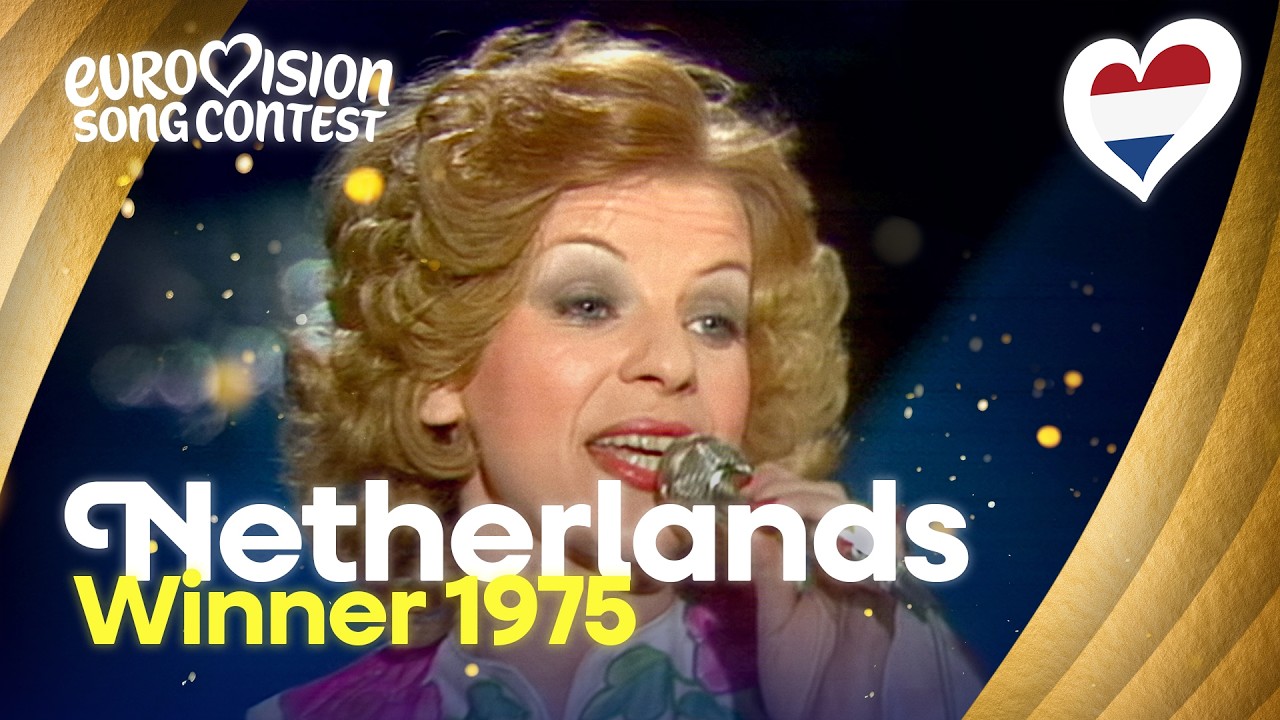
The 20th Eurovision Song Contest was held on Saturday, 22 March 1975 at Stockholmsmässan in Stockholm, Sweden. 19 countries took part. The Netherlands won with “Ding-a-dong” by Teach-In, on 152 points.
How would you have voted? Rank all 19 songs from 1975
- Date
- Saturday, 22 March 1975
- Venue
- Stockholmsmässan, Stockholm, Sweden
- Host broadcaster
- Sveriges Radio (SR)
- Presenter
- Karin Falck
- Director
- Bo Billtén
- Musical director
- Mats Olsson
- For the EBU
- Clifford Brown
- Entries
- 19 countries
- Debut
- Turkey
- Returning
- France, Malta
- Absent
- Greece
- Voting
- Each country awarded 12, 10, 8-1 points to their ten favourite songs
The story
Twelve points arrive, and Sweden regrets winning
ABBA had given Sweden its first contest, and Swedish television was not sure it wanted one.
The 1975 show was held at an exhibition centre in Älvsjö, in southern Stockholm, with Karin Falck presenting. It is remembered for one thing above all: this is the night the contest started giving twelve points.
A reluctant host
Sveriges Radio’s first objection was the bill, which fell on the host alone. It tried to get the EBU and the other broadcasters to share the cost. No agreement came in time, and Sweden paid for everything.
The second objection came from outside. Left-wing groups attacked the idea of a public broadcaster spending that kind of money on a commercial event, and the argument grew into a wider protest against the commercialisation of music in Sweden. There were demonstrations in the streets. During contest week a rival event was staged in Stockholm, the Alternativfestivalen.
Both arguments had consequences. The cost-sharing talks eventually produced a new system in which every participating country pays towards the contest. And Sveriges Radio, afraid of winning again and under pressure at home, decided not to enter at all the following year.
Nineteen
It was the biggest field yet. Turkey entered for the first time. France returned after missing Brighton, and Malta after two years away.
Greece, which had only just joined, stayed out. Turkey had invaded Cyprus the previous summer, and Greece is reported to have pulled out late — possibly rather than share a stage with it.
The United Kingdom sent the Shadows.
The threat
Swedish security police had intelligence that the contest might be targeted by the Red Army Faction, the West German far-left militant group. Security at the venue was tight throughout.
Nothing happened at the contest. One month later the same group attacked the West German embassy in Stockholm.
How twelve points was invented
After the abandoned experiment in Brighton, a working group of German, Swedish and Finnish broadcasters was asked to find something better.
The Germans suggested that each country rank nine songs. The Finns suggested ranking eight, with fourteen points for the favourite. A Finnish compromise would have given ten points to the favourite and eight down to one for the rest.
It was the BBC that proposed the pattern that stuck: twelve points for a country’s favourite, ten for its second choice, then eight down to one. It has been used at every contest since.
Behind the numbers sat a jury of eleven people in each country, aged from 16 to 60. Each member marked every song out of five as soon as it finished, and the totals decided who got the twelve.
One thing was missing. The points were read out in the order the songs had been sung, not from one up to twelve. The slow climb to “douze points” came later.
Rehearsal oddities
Two acts changed language between rehearsal and broadcast. Yugoslavia and Portugal both sang in English at the dress rehearsal, and in Slovene and Portuguese on the night.
The Dutch got an extra rehearsal, just before transmission. Their song was first in the running order, and their composer, Dick Bakker, had noticed that it always sounded worse than the others: the sound engineers were using the opening slot to sort out their equipment.
The show
Each song was introduced by a film of the performers backstage, painting a self-portrait and their national flag onto a blank canvas. The interval was a sequence of pictures by the illustrator John Bauer, the painter of trolls and gnomes, set to music by the orchestra.
The result
The extra rehearsal was not wasted. Teach-In’s “Ding-a-dong” won for the Netherlands with 152 points — the first time the song that opened the show had won it. It was the Netherlands’ fourth victory, level with France and Luxembourg.
The Shadows were second on 138. It was the ninth time the United Kingdom had finished runner-up. Italy was third.
Malta, last on both its previous attempts, came twelfth. Turkey’s debut ended at the bottom with three points.
Sources: Wikipedia, “Eurovision Song Contest 1975”, and the EBU records and Swedish press reports it cites.
On the night
How the show opened, and what filled the interval while the votes came in.
-
Saturday, 22 March 1975
The contest
19 songs
- opened by
-
- A film about Sweden a montage playing with the clichés about the country and its people
- in the interval
-
- “The World of John Bauer” the Swedish illustrator’s pictures, set to music from the orchestra
Every entry
| Place | Country | Artist | Song | Points | Sang |
|---|---|---|---|---|---|
| 1 | Netherlands | Teach-In winner! | “Ding-a-dong” English · Dick Bakker, Will Luikinga, Eddy Ouwens · conducted by Harry van Hoof | 152 | 1 |
| 2 | United Kingdom | The Shadows | “Let Me Be the One” English · Paul Curtis · conducted by Alyn Ainsworth | 138 | 9 |
| 3 | Italy | Wess and Dori Ghezzi | “Era” Italian · Andrea Lo Vecchio, Shel Shapiro · conducted by Natale Massara | 115 | 19 |
| 4 | France | Nicole | “Et bonjour à toi l'artiste” French · Jeff Barnel, Pierre Delanoë · conducted by Jean Musy | 91 | 3 |
| 5 | Luxembourg | Géraldine | “Toi” French · Phil Coulter, Pierre Cour, Bill Martin · conducted by Phil Coulter | 84 | 5 |
| 6 | Switzerland | Simone Drexel | “Mikado” German · Simone Drexel · conducted by Peter Jacques | 77 | 7 |
| 7 | Finland | Pihasoittajat | “Old Man Fiddle” English · Hannu Karlsson, Kim Kuusi, Arthur Ridgway Spencer · conducted by Ossi Runne | 74 | 15 |
| 8 | Sweden | Lars Berghagen | “Jennie, Jennie” English · Lars Berghagen · conducted by Lars Samuelson | 72 | 18 |
| 9 | Ireland | The Swarbriggs | “That's What Friends Are For” English · Jimmy Swarbrigg, Tommy Swarbrigg · conducted by Colman Pearce | 68 | 2 |
| 10 | Spain | Sergio and Estíbaliz | “Tú volverás” Spanish · Juan Carlos Calderón · conducted by Juan Carlos Calderón | 53 | 17 |
| 11 | Israel | Shlomo Artzi | “At Ve'Ani (את ואני)” Hebrew · Shlomo Artzi, Ehud Manor · conducted by Eldad Shrem | 40 | 12 |
| 12 | Malta | Renato | “Singing This Song” English · Sammy Galea, M. Iris Misfud · conducted by Vince Tempera | 32 | 10 |
| 13 | Yugoslavia | Pepel in kri | “Dan ljubezni” Slovene · Tadej Hrušovar, Dušan Velkaverh · conducted by Mario Rijavec | 22 | 8 |
| 13 | Monaco | Sophie | “Une chanson c'est une lettre” French · Boris Bergman, André Popp · conducted by André Popp | 22 | 14 |
| 15 | Belgium | Ann Christy | “Gelukkig zijn” Dutch, English · Mary Boduin · conducted by Francis Bay | 17 | 11 |
| 16 | Portugal | Duarte Mendes | “Madrugada” Portuguese · José Luís Tinoco · conducted by Pedro Osório | 16 | 16 |
| 17 | Germany | Joy Fleming | “Ein Lied kann eine Brücke sein” German, English · Michael Holm, Rainer Pietsch · conducted by Rainer Pietsch | 15 | 4 |
| 18 | Norway | Ellen Nikolaysen | “Touch My Life with Summer” English · Svein Hundnes, Johnny Sareussen · conducted by Carsten Klouman | 11 | 6 |
| 19 | Turkey | Semiha Yankı | “Seninle Bir Dakika” Turkish · Hikmet Münir Ebcioğlu, Kemal Ebcioğlu · conducted by Timur Selçuk | 3 | 13 |


Who showed it, and who talked over it
The channels that carried the contest in 26 countries, with the commentator where our source names one.
-
Belgium
- BRT, BRT 1 Jan Geysen and Robrecht Willaert
- RTB Paule Herreman
- RTB 2
-
Finland
- TV1 Heikki Seppälä
- Rinnakkaisohjelma Erkki Melakoski
-
France
- TF1 Georges de Caunes
-
Germany
- Deutsches Fernsehen Werner Veigel
-
Ireland
- RTÉ Mike Murphy
- RTÉ Radio Liam Devally
-
Israel
- Israeli Television
-
Italy
- Programma Nazionale TV, Secondo Programma Silvio Noto
-
Luxembourg
- RTL Télé-Luxembourg
-
Malta
- TVM, Radio Malta Norman Hamilton
-
Netherlands
- Nederland 2 Willem Duys
-
Norway
- NRK Fjernsynet, NRK John Andreassen
-
Portugal
- I Programa
-
Spain
- TVE 1 José Luis Uribarri
- RNE Canarias
- Cadena SER Joaquín Prat
-
Sweden
- TV1 Åke Strömmer
- SR P3 Ursula Richter
-
Switzerland
- TV DRS
- TSR Georges Hardy
- TSI
- RSR 1 Robert Burnier
-
Turkey
- TRT Televizyon
-
United Kingdom
- BBC1 Pete Murray
- BBC Radio 2 Terry Wogan
- BFBS Radio Terry Wogan
-
Yugoslavia
- TV Beograd 1
- TV Koper-Capodistria
- TV Ljubljana 1
- TV Sarajevo
- TV Skopje
- TV Zagreb 1
Also shown in
Results as published by the European Broadcasting Union. Spotted a mistake? Tell us and we'll fix it.